


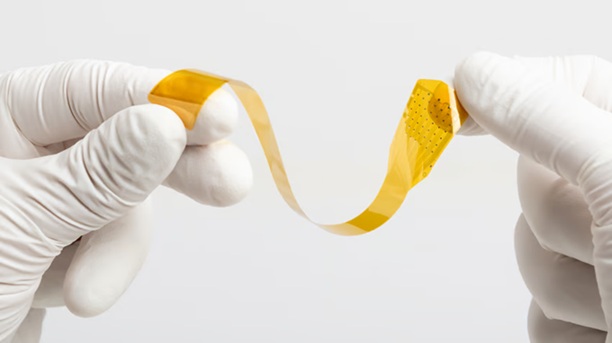
The Layer 7 cortical interface, which was cleared by the FDA this year, packs 1,024 electrodes onto a thin film about the size of a postage stamp. (Precision Neurosciences)
By Conor Hale – October 3, 2025
The brain-computer interface developer Precision Neuroscience has put forward a study detailing the experiences of its first human patients—showing its minimally invasive approach is capable of both collecting high-bandwidth neural data and delivering stimulation without penetrating deep into tissue.
Published in Nature Biomedical Engineering, the paper examines the design of the company’s Layer 7 cortical interface as well as its preclinical testing and clinical pilot, which included five patients who underwent brain activity mapping during neurosurgery.
The Fierce Medtech Fierce 15 winner describes its approach as modular, scalable and reversible: the Layer 7 is designed to be temporary, with 1,024 electrodes placed on a strip of thin, flexible film that can be slipped onto the surface of the brain through a straight, sub-millimeter incision in the skull. More than one can be used at a time, and Precision Neuroscience has previously deployed four of the postage stamp-sized implants to cover as much as eight square centimeters of gray matter.
The device received a clearance from the FDA earlier this year, greenlighting it for open surgery to help clinicians avoid critical areas of the brain during a procedure—and allowing its use while the company continues to develop its software platforms for decoding brain signals, as it works towards its goals of aiding patients with paralysis, ALS and other conditions.